
Relocation case management for HR teams
One case per move. Catch the slip before the start date.
Run every international move to your policy, with each step owned and dated — and a slipping start date flagged in time to act.
For employers and their HR teams. Moving on your own? See what changes for individuals.
30-minute walkthrough on one of your own corridors. No commitment.
Critical pathEmployment permitOwner: HR + employee
Critical pathEmployment permitOwner: HR + employee
Sourced
700+ reviewed requirements, each linked to its official source and dated.
Owned
Every step has an owner and a due date: HR, employee or provider.
On the record
Every decision is logged. Each case closes with its full history.
Relocation still runs on email and spreadsheets.
- 01
HR is accountable for outcomes they cannot see.
Status lives in inboxes, not in systems.
- 02
Vendors operate outside the case, not inside it.
Provider progress is invisible until something goes wrong.
- 03
Every delay is a cost, a compliance or a retention risk.
Handoffs are untracked. Deadlines are missed before anyone notices.
The product
One case per move. Everyone works from it.
Not an agency, not a marketplace: the system of record HR, the employee and providers share.
Know a start date will slip — while there is time to act.
ReloPass knows how long each step takes on the route and for the person moving, and warns HR when the plan no longer fits the start date — with the shortfall in days. HR reviews the roadmap before the employee sees it.
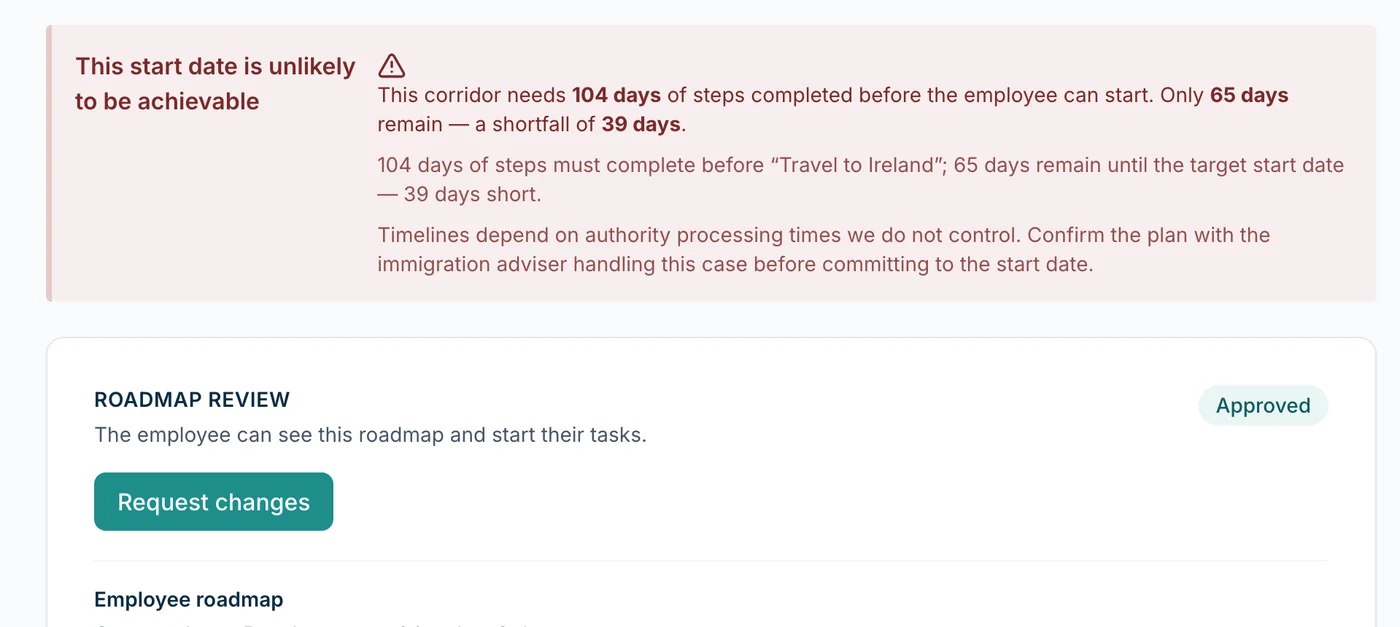
- 1The shortfall, in days — not a vague red flag
- 2Built from the route’s own lead times
- 3HR approves the roadmap before the employee sees it
The employee sees what applies to them — and where it comes from.
Requirements are filtered by nationality and route, with the source on the line. Fewer questions to HR, fewer surprises at the border.
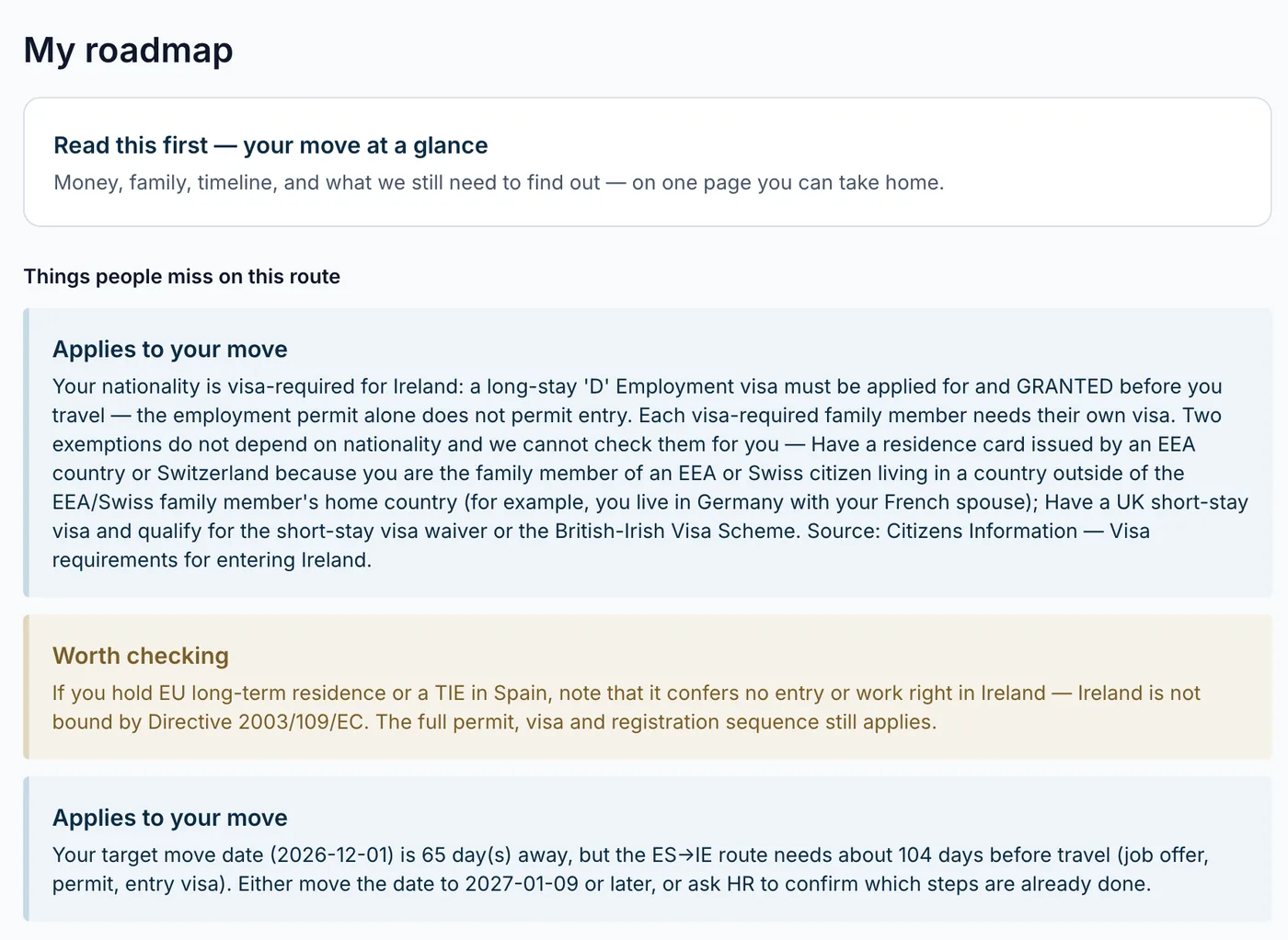
- 1What people usually miss on this route
- 2The official source, on the line
- 3Timing checked against this move date
Every task has an owner and a date.
The employee, HR or a provider — each step says who does it, by when, and whether it is blocked. Nothing waits in someone’s inbox.
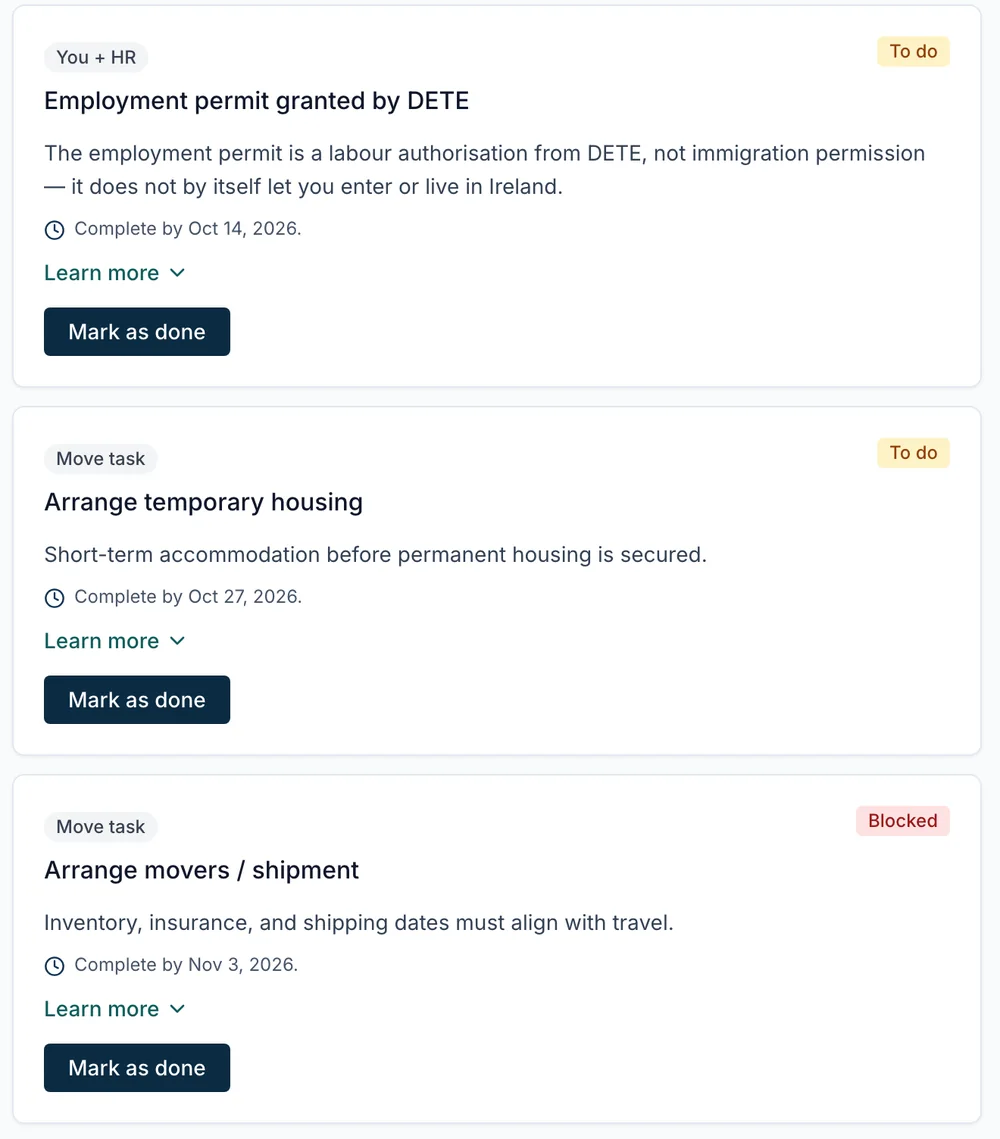
- 1Who owns the step
- 2When it is due
- 3Blocked steps stand out
Product screens from a demo case. Names and company are demo data.
Built corridor by corridor
Deep on the routes we run — not thin on every country.
Each corridor carries its own reviewed requirements, lead times and the things people miss. We cover Ireland, Germany, Norway, Spain, France and the Netherlands in depth.
Corridor guides
- Ireland250+
- Germany100+
- Norway100+
- Spain80+
- France80+
- Netherlands75+
Who it is for
One case, four people who need it.
HR & People leaders
See every move and who owns the next step.
For HR teamsFinance
Put a number on late and failed moves.
Estimate the costGlobal mobility
Run policy, providers and timelines per corridor.
How it worksRelocating employees
Know what’s needed, by when, and who handles it.
Get the checklist
Moving on your own, without an employer? Today ReloPass works through employers: your HR team sets up your move.
What it’s worth
What does one missed handoff cost you?
Change any figure — the estimate updates as you type.
A starting estimate of what one place — instead of everyone chasing everyone — saves a mobility team each year. Every figure is editable; the defaults are illustrative, not a quote.
Your numbers
Roughly, for your team as it runs today. Adjust anything — the estimate updates below.
An illustrative model to frame the conversation, not a commercial quote. It leaves out the things hardest to price and easiest to feel: an employee who arrives ready to work, and an HR team that can prove every decision was made to policy.
A relocation is a record you may have to defend.
What an employee must do comes from reviewed, cited rules for their route. Where ReloPass drafts or summarises with AI, a person approves the result before anyone sees it.
A person approves every recommendation
Nothing reaches an employee until someone on your team has approved it.
Grounded in your policy, and cited
Answers come from your company’s own policy and curated corridor rules — with the source shown, not a guess.
Every decision is logged
Each step is recorded with the information that informed it — an audit trail you can hand to any reviewer.
Personal data is masked
Passport numbers, IBANs, national IDs, phones and emails are masked before any text is sent to an AI provider.
Requirements are served, not generated
What an employee must do comes from reviewed, cited data for their route — never written fresh at the moment they ask.
One record, reusable
Every move leaves a record, so the next one on the same corridor starts from what the last one learned.
Start with one corridor.
Priced per move — your company pays per relocation case; the employee never pays. Tell us how your relocations run today and we’ll show you what changes.